Our surname, Paulding, actually started out as Pollard and morphed several times over two centuries. Below is a timeline of the changes.
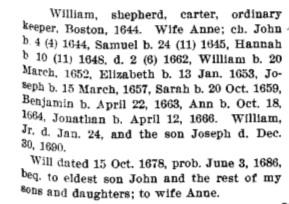
A little primer. (b. stands for birth date – ch stands for children – m for married – w for wife – d for died) etc. Genealogy book shorthand. b 4 (4) 1644 means born 4 April 1644 or in current times, April 4th, 1644.
The below information is from books published by various Historical Societies in New England.
1630
William Pollard
The first of the P surname was William Pollard who married Anne Dison. We don’t know exactly when William arrived but Anne came on the Winthrop fleet in 1630 and was the first white female to step foot on what is now Boston. She lived to be 105. Her portrait was painted at age 100 and is on display at the Massachusetts Historical Society. William and Anne had several children including John Pollard born June 04, 1644.
1644
John Pollard
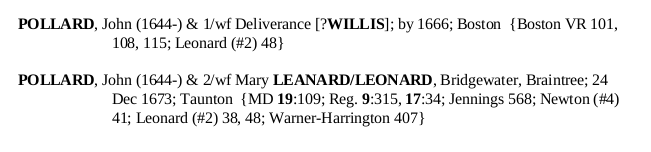
John Pollard b. 1644 married twice. First to Deliverance Willis and they had three children. Second to Mary Leonard of Taunton who’s family had moved there from Duxbury. They had three more children including another John Pollard born Mar 20, 1675
1675
John Pollard
John Pollard b. 1675 in Taunton married Lydia Tilson and they move to Plymouth and then Duxbury. It’s here that the first name games begin. When married they are referred to as John Pouldand and Lidiah Tilson and later in a record with their children it says John Polland and his wife Lidia Poland with the children all listed as Polden. There’s also a court record with a the charge of fornication “she being with child” that has them as John Polden and Lydiah in 1703. Regardless of the reason for the name change, it sticks for the next 150 years. John and Lydia had several children including Thomas born Apr12, 1712
1712
Thomas Polden
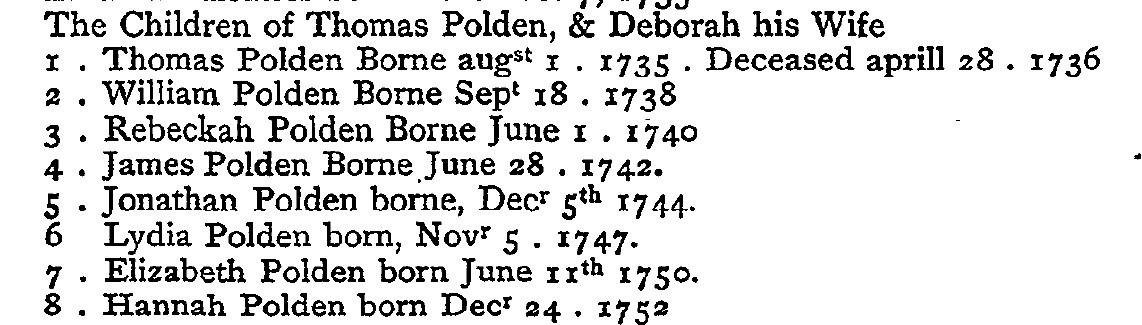
Thomas Polden, son of John and Lydia Pollard/Polden, married Deborah Spooner in Plymouth and they had several children including James Polden Sr born Jun 28, 1742 Oddly enough, this Church record has Polland, Poland and Polden as the surnames for one family.
1742
James Polden Sr
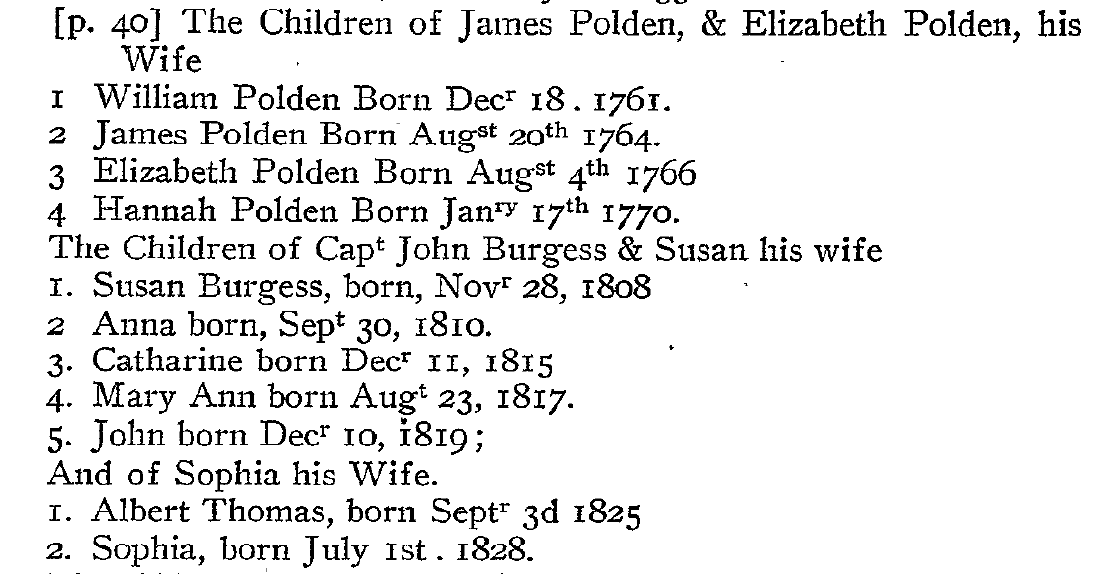
James Sr married Elizabeth Beale in 1761 and they had four children, including of course, James Jr born Aug 20, 1764
1764
James Polden Jr
James Polden Jr married Bethia Donham in 1784 and they also had four children including John Polden born 1792
1792
John Polden
This John Polden moved to Duxbury and married Rebecca Weston, a Mayflower Descendant. Married in 1813 they had two boys including Joshua Thomas Polden Sr later in 1813 though he would not remain a Polden.
1813
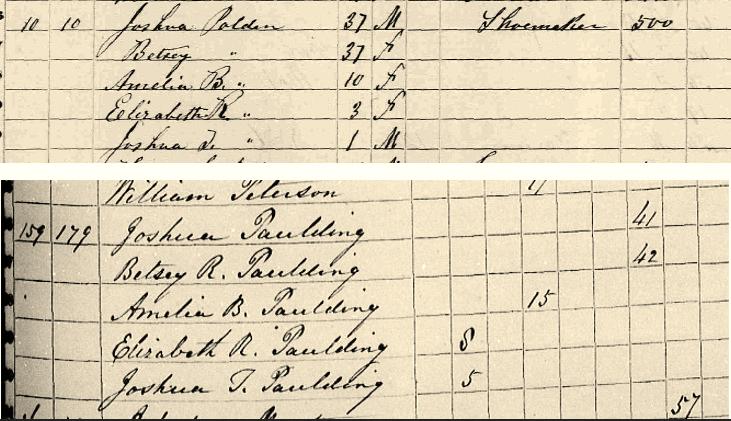
Joshua Thomas Polden Sr becomes Joshua Thomas Paulding Sr
My Great Great Grandfather Joshua Thomas Polden Sr married Betsey Atwell in 1839 and they only had a son born Jun 26, 1850 as Joshua Thomas Polden Jr and shows as such in the 1850 census but for the 1855 census Joshua Sr, wife Betsey and Joshua Jr, now 5 years old, are listed as Paulding, as are the rest of the children. I see there’s a note on his tree page stating;
Patricide is defined as: The act of killing one’s father (patricide), or less commonly one’s mother which is (matricide) or some other close relative, but usually not children. Captain Elisha Sampson
The son, Simeon, was one of those family secrets and it turns out, he is the twin to our paternal great grandmother, Sylvia.
We had an ancestor die at the Tewksbury Almshouse so I did some research to find out what an almshouse was and specifically Tewksbury but that also led to other facilities. What I found was the sad tale which becomes nightmarish at times.
Tewksbury Almshouse
The Tewksbury Almshouse in later years as a hospital for people with Consumption.. (Consumption, phthisis and the White Plague are all terms used to refer to tuberculosis throughout history)
The 1800s saw a huge influx of immigrants, especially the Irish due to the Great Famine of 1845-1852. The population grew so fast that there was not enough housing or jobs for all. As such, most almshouses had a high percentage of Irish inhabitants.
One of three alms houses built in the mid 19th century to house the poor. Tewksbury was built between 1852-1854 and opened on May 1st 1854. Within one week the 500 bed facility had 668 people housed there, over 800 by May 20th and by December 2, 1854, 2,193 “paupers” had been admitted.(1)
State paupers ; that is, those born of parents not having any legal settlement in this State, and no others ; and j-ou know it requires a certain term of residence in this State, and the paying of certain taxes, both, to give a settlement.(2)
Here’s where the story can take two different paths depending on the source and though both are truths, they are quite opposing. The history according to the Tewksbury Historical Society and the Public Health Museum (located int the old administration building at Tewksbury Hospital) both like to tell the tale of Anne Sullivan. Johanna Mansfield Sullivan better known as Annie who would become Hellen Keller’s teacher and companion. She was mostly blind by the age of seven and her mother passed away a year later. Two years after that, in 1876, her father left and she and her brother Jimmie were admitted to Tewksbury. Admittance forms state she had sore eyes and Jimmie had hip pain. He would die three months later. After four years Annie managed to leave Tewkbury to attend Perkins School for the Blind. She did so by throwing herself at inspectors that had arrived from the State Board of Charities and begging them to let her go to the new school. Later in life she is quoted describing Tewkbury as indecent, cruel, melancholy and gruesome though at the time it was just how life was as she knew nothing more. She was lucky to make it out of there alive due to the general conditions, overcrowding and lack of the state of medical technology of the times. One of the buildings was later named in honor of her. Even wikipedia gives an extra clean version though they do cite the article as needing an entire re-write.
Mr. Isaac H. Meserve was the first superintendent. The Honorable Thomas J. Marsh succeeded him in 1858, and he held the office for over twenty-five years. The “honorable” Marsh was also known as Capt. Marsh but no one seems to know what he was Captain of. Perhaps a captain of industry. The industry of cheating the poor, sometimes even of their lives. From 1858 until 1883 over 60,000 poor souls had the misfortune of entering Tewksbury with many, if not most being carried or carted out. Mr Marsh along with several family members turned Tewksbury into a money making racket, profiting off of anything or any one they could. A man of little means when he started in at Tewksbury, Marsh managed to send four children to universities including two that attended Harvard. A sick irony is that according to a resident, Marsh made quite a bit of money from Med schools including the one at Harvard. His product? Dead bodies for dissection. $3-5 for infants with adults being closer to $15. Bodies that weren’t up to par for dissection were still turned to profit with the tanneries and fishing industry. Yes, Leather and bait. There was no physican at Tewksbury so one of the female Marshes played the role. Her favorite treatment for infants, who capt Marsh referred to as critters, was morphine to keep them quiet. An insane resident was her assistant and once quieted an infant with a pillow. In one year the facility had 72 infants and of those, only one survived. The Marshes also profited from food and goods. These items were paid for by the commonwealth and meant for the residents but never got to them for the most part. They also never saw their own belongings again for once you were admitted, you were given a hospital gown and your belongings disappeared. Some of the Marshes had other businesses including a second hand store and a boarding house, with meals served. During the last several years of the Marsh reign of terror, there were many complaints but they were overlooked due to political reasons. In 1883 an inspection was done of Tewksbury and it was a glowing report that fails to mention the above atrocities as well as the fact that diseases were spread by lack of bathwater changes, especially with the infants or that if you were incapacitated, you were likely to have holes chewed in you by the rampant vermin.(2)A politician however, was also the reason for the Marshes being “removed” from Tewksbury. Benjamin Butler became Governor in Nov 1882 and was a man of the people at the tome though he had a reputation as an opportunist. In 1868, Butler played a key role in the impeachment and trial of President Andrew Johnson and three years later wrote the initial draft of the Civil Rights Act of 1871. A sponsor of the Civil Rights Act of 1875, which called of equal access to public accommodations, he was angered to see the law overturned by the Supreme Court in 1883. After unsuccessful bids for Governor of Massachusetts in 1878 and 1879, Butler finally won the office in 1882. While governor, Butler appointed the first woman, Clara Barton, to an executive office in May 1883 when he offered her oversight of the Massachusetts Reformatory Prison for Women. In 1884, he earned the presidential nomination from the Greenback and Anti-Monopoly Parties, but fared poorly in the general election. Leaving office in January 1884, Butler continued to practice law until his death on January 11, 1893. Passing in Washington, DC, his body was returned to Lowell and buried at Hildreth Cemetery. Of course politics being the way it is, the Hon. Capt. Marsh was replaced, not imprisoned and the alms houses returned to the status quo, though that status changed with the times as most of them would become asylums and State Hospitals for the Insane. The definition of insane included those labeled by medical terminology of the times as; feeble-minded, morons, idiots and epileptics. Residents also included orphans, unwed mothers and the destitute even as the facilities became more asylum than alms house. For a time, Irish made up more than half the residents of these places. They were considered a lower class by wealthy ex-Englishmen who were now men of positions in the New World and the potato famine of Ireland nearly doubled the population of the Boston area in one year overloading what little infrastructure there was.
The changes brought about by Gov Butler had widespread positive effects but unfortunately not long lasting. Atrocities on the lower class were about to be backed by big money and science in the form of eugenics. A belief that all physical and psychological defects were hereditary and that this new country could and should be cleansed of these defectives. One of the leaders of eugenics was the President of Harvard at the time. by John P.